Monday, March 17, 2014

New products for the market and elsewhere - soap, lotion bars, and lip balm.


We got bored this winter and decided to branch our little business into an additional direction this winter by offering soap, lip balm, and lotion bars.  Meridith has been going crazy in the kitchen concocting a variety of these homemade skin products and we will have them for sale when we make it to the Capital City Farmer's Market this spring.  You can also order them directly from us by sending an email to meridithbenter@gmail.com with what you want.

Lip Balm


Our lip balm is made from organic beeswax, shea butter, and coconut oil.  We currently have mint, chocolate mint, strawberry, and classic beeswax flavors.  We plan to offer lip balm with sunscreen very soon, as well.  $3 per tube.

Soap 


Our soaps are made with essential oils and natural ingredients.  Some soaps include whole bits of rosemary, oatmeal, grapefruit skins, orange peels, and poppy seeds.  $3-6 per bar.  We currently have the following line up of soap:

Rosemary Mint
Oatmeal
Grapefruit
Citrus
Tea Tree
Gardener's Scrub (with citronella for bug repellant)

Lotion Bars


lotion bar

We had never heard of lotion bars until a few months ago, but we are blown away by how well they heal dry skin, even in the dead of winter.  Lotion bars are like lotion, but in bar form.  Just rub the lotion bar on your skin to add moisture and healing oils.  $5-6 per bar.

If you would like to purchase any of these products, simply email us at meridithbenter@gmail.com.

Tuesday, March 11, 2014

"What are those little spots in my eggs? Why is my egg white cloudy?"

These are two questions you may ask yourself when you crack open one of our eggs.  There will be differences from store-bought eggs, and if you didn't know better you might think the egg was bad.  So read on if you're one of our egg customers or simply interested in the characteristics of farm fresh eggs.

Those little small red or brown flecks near the yolk - These have one of the worst sounding names you're ever heard when it comes to eggs: meat spots.  Yes, they're called meat spots.  There is another similar condition called blood spots, which doesn't sound any better.  But don't freak out!  They won't kill you, and it's ok to eat an egg with a meat spot.  If it really bothers you, you can pick it out with a spoon or something.

There is a good description of meat spots at thepoultrysite.com

It isn't possible to detect some of the smaller meat spots when we candle the eggs for quality, so you might get one.  Our eggs are more likely to have meat spots than store-bought eggs because we have older chickens.  Meat spots become more common as the hen ages, and we have some hens that are as old as 5 years.  Along with more meat spots, the hens also lay fewer eggs as they get older, so a typical industrial egg operation kills the hens as soon as egg production and quality decrease.  A hen in an industrial egg operation is killed before it reaches a year and a half.  While we aren't against turning an old hen into chicken soup, we like our hens to live quite awhile past their second birthday.  For this reason we will tolerate the occasional small red fleck as long as you can, too. 

Here is what the Egg Safety Center says about meat spots:

"Blood or meat spots are occasionally found on an egg yolk and are merely an error on the part of the hen. They’re caused by the rupture of a blood vessel on the yolk surface when it’s being formed or by a similar accident in the wall of the oviduct. Most eggs with blood or meat spots are detected by electronic spotters and never reach the market, but even with electronic scanners it’s impossible to catch them all. Eggs with blood spots and meat spots are fit to eat."

So don't worry about meat spots. 

Cloudy whites - When the white of the egg looks like it has been slightly cooked and is cloudy, there is nothing wrong with the egg.  A cloudy white is actually a sign of extreme freshness.  We typically see cloudy whites in eggs that have been laid in the last day or two.  The cloudiness is caused by carbon dioxide gas trapped inside the egg.  As the egg ages, this gas is released and the white clears.  So there's nothing to worry about with a cloudy egg white.


Wednesday, October 30, 2013

Lousy weather, winter preparation

Gray skies, cold rain blowing around.  Snow.  Though it is still fall, wintery conditions have descended upon our corner of the planet.  There isn't much left to look at that is green in the gardens, though some spinach, broccoli, and arugula plants cling to life.  We have fed the last of the leftover watermelons to the chickens, and the carrots, sweetened by the frost, are all in storage.  One would think there isn't much left to concern ourselves with out there in the cold, horizontal rain, and instead a person with any sense at all would cozy up inside for the winter.  One would be wrong, however. 

Thankfully, we have most of the really urgent tasks completed.  The first priority was getting the chicken coop windows sealed up so the girls didn't freeze to death.  I cut a few plywood boards to fit the windows and attached them with bolts and wing nuts for easy removal in the spring.  We also hooked up a light on a timer to extend the length of the day, which stimulates the hens to lay more eggs.  The chickens prefer that the light come on early in the morning rather than staying on for awhile after dark in the evening.  They have a hard time finding their roost 2x4's in the pitch dark, and chaos ensues in the coop, which is never a good thing.  We also shoveled all of the poopy bedding out of the coop.  We let it accumulate throughout the summer, constantly enriched by droppings, and then mix it with all the dead plants we remove from the gardens (except for the corn stalks) and let it compost.  The corn stalks are placed on the floor of the chicken coop and covered with a little bit of straw to be the base of their bedding for the winter.  We enjoy utilizing any organic matter we produce in the most efficient possible way, so using some of the plant matter as chicken bedding allows us to get a second use out of a material rather than just turning it straight into compost.

Removing all rest of the dead plants is a fairly thankless job.  The tomato plants are the worst - you get splattered rotten tomatoes and they squish under your feet as you walk through the garden.  It is a bit unsettling.  Adding to the work is the fact that we prefer to leave the roots of the plants in the ground as part of our efforts not to till the soil, so we cut the plants off at their base with a shears.  We're not quite done with that part yet, but the nice thing is that it doesn't necessarily have to be done right away.  We could leave it until spring if we had to, though that is not ideal. 

This spring we laid down landscaping fabric between the rows when thousands of tiny weeds plants began sprouting.  Hopefully this removed many of the seeds from those areas.  We would like to pull up the fabric before winter sets in.  We hope to not need the fabric in the future if we are able to reduce those pesky weed seeds with the use of cover crops and no-till.

We managed to get a few fall cover crops planted that will die when they encounter true winter conditions, but next year we would like to do more.  We experimented with planting a cover crop in mid October, but as of yet the seeds have not germinated and at this point I would be surprised if they did.  

There is plenty of work left if we look for it, but for the most part there is not much left to do but care for the chickens and plan for next year.  By the time next spring rolls around we'll be champing at the bit to do it all over again.


Monday, September 30, 2013

Wrapping up the 2013 growing season


In our first year of selling produce at the Capitol City Farmer's Market we have learned a great deal.  The most obvious lesson is that it is hard to sell tomatoes during a really great year for tomatoes.  Pardon the cliche, but if I had a nickel for every time I heard someone walk by our stand and say, "Don't need tomatoes, got plenty of those" I would be a very rich man.  In fact, if they bought all of our tomatoes at a nickel a piece, I would still be a moderately wealthy man.  It isn't as though we didn't sell any of our tomatoes this year; we did.  But the 85 plants we put in the ground were more than enough, as evidenced by the ripe red tomatoes still on our plants that we can no longer find the motivation to pick.  I walk by the tomato garden, noticing the many tomatoes to be picked, and for a brief moment I marvel at the value of all those tomatoes if they were made into canned goods or slapped on a BLT.  Then the moment passes, and I quickly move on, realizing that we have canned more this year than ever before, and unless someone wants to come and pick them, we are pretty much over it.  So next year we will sell some tomatoes, but it won't be part of our business plan to make heirloom tomatoes a primary focus of our efforts.  The market for tomatoes is only so big in a town where many people grow their own.


On the bright side, we found other crops to fill the void left by the tomatoes.  Peppers have captured our attention as gardeners, and based on how well they sold it seems they have also captured the attention of our customers.  Our bell peppers sold very well, with the small sweet red Buran peppers and orange bells selling the best.  To our delight, they also produced remarkably well for the little amount of attention given to them.  We see much greater potential in selling peppers than we do tomatoes - most gardeners grow their own tomatoes, but not as many grow peppers.  So we figure that, with more attention and tender loving care provided to the peppers, we can improve on our yield from this season and to top it off we will almost definitely be able to sell them.  That has been the big sticking point with our crops this year - we can certainly grow them, but can we sell them?  What we have learned is that you don't really know until you try.

Onions are another crop we would like to expand upon.  We didn't even plan to sell onions this year, but we had such a great crop of monstrous Walla Wallas and Red Zeppelins that we ended up selling quite a few just to get our personal stash down to a level where we could eat them all before they went bad.  The Walla Wallas sold very well, but they have a major drawback in that they do not keep nearly as long as some other sweet onion varieties.  We will grow some again next year, but only enough for fresh selling and eating.  We intend to grow more of the Yellow Sweet Spanish, which we found to be a very tasty onion that keeps well.  And on the advice of our fellow vendors, we will grow a nice sized patch of the Candy Hybrid onion, which keeps very well and is as sweet as a Walla Walla.  We see good things ahead on the onion horizon... if there is such a thing as an onion horizon.

Another thing we learned is that we need to make our operation more efficient.  This a recurring goal, as we are constantly looking for ways to grow more delicious food in the least impactful way that requires the least amount of effort.  It isn't as though we are averse to hard work - that's pretty much all we do these days - but the more efficiently we can garden, the more we can grow and the more free time we have to do other enjoyable activities like camping, fishing, and simply getting some sleep.  Our plan of growing less tomatoes and more peppers and onions plays into this, because the former are a giant pain to pick and the latter are relatively quick and easy.  We have spent a solid 30 hours or more picking tomatoes this year, and we haven't seem much return on our time investment, so there is much room for improvement.

The most important upgrade in efficiency will be to install drip irrigation systems in all of our gardens.  Currently we only use drip irrigation for trees, shrubs, and our small vineyard of grapes for winemaking, which we installed this spring.  With the flip of a switch we can water over a hundred trees and shrubs all at once with great precision and without getting the plants themselves wet.  That last point is important because watering from above with sprinklers creates a moist environment well suited for disease outbreaks.  We have seen the evidence firsthand when we have used sprinklers.  Drip irrigation, on the other hand, is simply black plastic tubing run along the ground to which many styles of emitters may be attached, ranging from micro-sized sprinklers to drippers that emit water at a specific rate, allowing you to figure out exactly how much water each plant received.  If we install drip irrigaton to our gardens as we have planned, we can water everything at once without the specter of disease and conserve water at the same time.  It is pretty tough to beat that kind of set up.  Drip irrigation is also vastly superior to soakers hoses in that it lasts much longer before needing to be replaced and doesn't routinely spring leaks that send streams of water flying across the garden for no good reason.  We tried the soaker hoses last year, and they were ok, but nothing compared to drip irrigation.


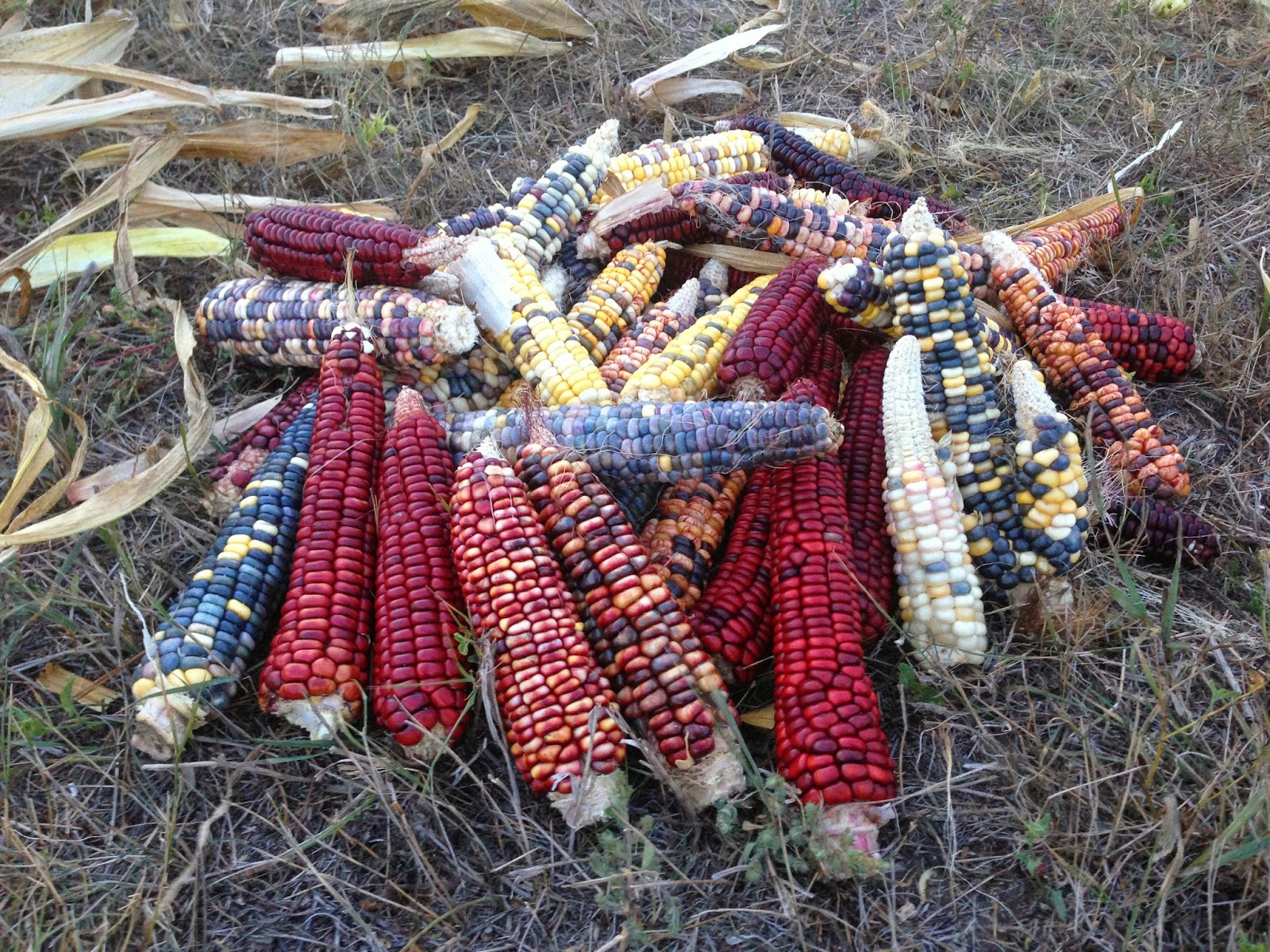
The growing season may be pretty much done with for this year, but we will still be making another market appearance or two in October.  We have some goodies for you all, like Mandan Bride corn flour of which we have written on several occasions, and we've got some interesting popcorn varieties we would like to share with you, as well.  See you there!

Monday, August 26, 2013

Heirloom tomatoes - supremely ugly; wonderfully delicious

Our 2 1/2 pound ugly as sin Cherokee Purple
If you're idea of a good looking tomato is round and red with no cracks, blemishes, or irregularities, you probably wrinkly your nose at the sight of an heirloom tomato.  It's okay, I understand.  I used to be the same way.  Like good beer and fine wine, it takes an adventurous state of mind to delve into the vast world of heirloom tomatoes.  There are so many varieties, so many colors, and so many are so incredibly ugly.  Familiarity builds affection, however, and after awhile a ripe, bulbous, green and violet Cherokee Purple or Black Krim becomes a thing of beauty rather than something from a tomato breeding experiment on the Island of Dr. Moreau.  It is the flavor rather than the appearance that attracts many people to heirlooms.  Sure, there are some beautiful heirlooms, but they are not the round red tomato society has come to expect.  We want you to know that there is nothing to be afraid of with ugly tomatoes.  You're not going to marry them, anyway, and in the meantime they have great personality. 


Some Background Information On Heirloom Tomatoes


All tomatoes originate from South America.  As early as 500 BC tomatoes were being grown for food by the Aztecs.  When Spanish conquistadores brought seeds back to Europe, the tomato became a staple part of the diet.  Seeds migrated to Italy and other parts of the continent and eventually became a staple part of the cuisine.

An heirloom is a open pollinated variety, meaning you can save the seed from it, that has been passed down for generations.  There are varieties such as Purple Calabash that supposedly go back as far as the Aztecs and there are newer ones that have been crossed with disease resistant varieties to create an "improved" variety.  We've grown Purple Calabash and have to say that we weren't particularly impressed, but that is possibly a testament to the improvements that have been made over the years to create phenomenal heirloom varieties such as Brandywine and Pineapple.  Countless generations of people have saved seed from the best tomatoes on the best plants, with emphasis on whatever traits or colors for which they were selecting.  That is the beauty of heirlooms - people made them for what people really want, and that is great tomatoes.

Most heirloom varieties develop "green shoulders".  This is where the top of the tomato is still green and the bottom is soft and ripe.  The shoulders are green because they contain chloroplasts, which as you may or may not remember from high school biology, photosynthesize and produce sugars which wind up in the tomato.  The gene that causes green shoulders was recently discovered, and as you have probably noticed from looking at the tomatoes in the grocery store, has been bred out of most modern commercial varieties.  This gene may be one reason heirloom tomatoes taste better than grocery store tomatoes.  Another likely factor is that commercial tomatoes are usually picked green and ripened during shipping while a locally grown heirloom is allowed to ripen on the vine.

Heirlooms We Are Growing This Year


Rutgers - A variety released in 1934 in Rutgers, NJ.  At the time, this tomato was revolutionary for its combination of great flavor, uniformity, thick skin (though very thin by today's commercial standards), and resistance to cracking.  We grow this tomato for those that want a ripe red tomato without too many blemishes.  The flavor is outstanding and they are quite meaty, which makes for good sauce and a savory juice.  More information on Rutgers.

Super Sioux - This is an improved cultivar of the "Sioux" variety developed in 1944 at the Nebraska Experimental Station.  A round red tomato, we chose this variety because it sets fruit and produces well in a hot and dry climate such as we have near Pierre.  These tomatoes are on the acidic side, more so than Rutgers, which makes them ideal for canning.  They are also quite juicy, and we have made excellent tomato juice with them. 

Cherokee Purple - This variety has an interesting story behind it and is said to have originated with the Cherokee people.  Seeds were first listed for sale in the 1991 Seedsavers Exchange Yearbook and it has flourished in popularity ever since.  This tomato is often oddly shaped and a light purple in color.  The flavor is sweet yet surprisingly full and rich, which moderate acidity.  The seed cavities are small.  This is our first year growing these tomatoes and we are absolutely delighted with them.  We had one tomato that was 2 1/2 pounds this year!  And the flavor is up there with favorites such as Brandywine and Pineapple.

Speaking of Brandywine, we planted this famous variety that originated with the Amish this year but have yet to pick a tomato.  We're not really sure that there are even any green tomatoes on the plants.  It isn't looking good, but that is somewhat common with this pink, thin skinned variety known for its intense, delicious flavor.  They are not the easiest to grow, but they are usually worth the effort.  This variety commonly wins taste tests and is known far and wide for its flavor.  We grow the "Sudduth's Strain" of Brandywine, which are bigger and more on the pink side than the common strain.

Pineapple is a multicolored variety, with yellow at the top and orange and pink near the bottom.  Very large tomatoes up to a pound and a half that are very sweet and low acid, this is the perfect tomato for a gorgeous BLT.  With their outstanding flavor they are also excellent for fresh eating. 

We hope more people eventually come around to enjoying ugly tomatoes as much as they like the round red ones.  Not just because we enjoy growing them, but because heirlooms are truly the tomato lovers choice when it comes to flavor.  So remember that beauty is only skin deep, and if you want a great tomato, don't judge a book by its cover.

Thursday, August 22, 2013

Tomato season is upon us, and melon season nearly so!

The melon and squash jungle

Well, we are fully into the swing of things for the season.  Our kitchen table has been inundated with tomatoes and cukes.  We have been selling our produce at the farmer's market for 4 weeks in a row with very good results.  Our little business looks to have great promise!  And it isn't without joy.  Every Saturday morning we look forward to the day's market and every Saturday afternoon we comment on how much we enjoyed ourselves.  So cheers to both you and us for making this such a positive experience.

The unexpected cool August weather slowed down the ripening process for our main crops, but they are now coming along nicely with the current warm temps. 


We are getting many ripe tomatoes.  The varieties that we've harvested and will be selling this coming weekend are as follows:

Cherokee Purple
Rutgers
Black Krim
Super Sioux

Desert King Watermelon

The watermelons are not quite ripe, but they are certainly numerous.  Hopefully they ripen soon and we can start bringing them to the market.  Our yellow fleshed Desert King water melons really love hot weather, and heat also contributes to their sweetness, so we'll be watching the weather reports and hoping for the hot stuff.

Buttercup Squash

Butternut Squash

It also won't be long until we have squash.  We have two varieties, Buttercup and Butternut.  I can't tell you how many times we've said one and meant the other.  The Buttercups are very sweet and smell almost like a cantaloupe when you cut them open.  The Butternuts are more nutty, as their name implies, and not as sweet.  Our personal favorite is the Buttercup, but taste is relative and many people prefer Butternut.  To each their own, we say!

Orange Bell Pepper
Our peppers have also been producing.  We sold some green bell peppers and gypsy peppers over the last few weeks, and our colored sweet bells are just starting to color up, so we're almost at peak pepper production time.  We have a ton of peppers on the plants and should be well stocked with them at future markets.  We really love making stuffed peppers or just chopping peppers and freezing them for later use in things like chili and fajitas, so we'll have a fortunate dilemma in deciding how many to sell and how many to keep. 

Sunday, July 28, 2013

Market success, cover crops, fall crops, and growing chicken food


We had a great time at the Capitol City Farmer's Market on Saturday.  We sold all of our produce except for a few bunches of herbs.  We learned a lot of new things about selling our produce, such as having bags on hand for customers and labeling our goods more clearly.  We are looking forward to next weekend.  We should have mostly the same products on hand, but I'm sad to say that we're out of Mandan Bride corn flour until this year's crop ripens and dries. 

Meridith planted a whole bunch of seeds under the grow lights for a fall crop of spinach, swiss chard, arugula, lettuce, and broccoli.  We didn't have much success with our fall crops last year, but we had a pretty early frost.  Speaking of frost, we were scared might have gotten one the other day when our outside thermometer read 39 degrees F at sunrise.  I ran out of the deck looking for frost and was relieved to not find any. 


We picked a bunch more onions today and we will have more of those at the market next week.  We will also have leeks, yellow squash, zucchini, Sungold cherry tomatoes, some herbs, and perhaps some loaves of freshly baked bread.

Today we began planting cover crops in our corn that will form a thick mat of organic matter and break up the soil, then die at the first fall frost.  Our mix includes radishes, turnips, yellow mustard, cowpeas, and oats.  As we harvest crops this summer, we will plant this mix in any newly open patch of soil. 


We made some improvements to the chicken pen as well, by reclaiming some ground where the chickens had killed the grass and nothing was growing but creeping jenny.  We pulled the creeping jenny, tilled, and planted a mix of flax, yellow mustard, radishes, and turnips.  This mix should provide nutritious feed for the hens.  Next year we can use these beds to plant more forage crops throughout the spring and summer like sweet clover, oats, millet, and the others mentioned above. 

Saturday, July 27, 2013

Mandan Bride Honey Cornbread Recipe

Best get your cornbread makin' shoes on, here's a recipe for honey cornbread that we've been making with Mandan Bride.  It is light, creamy, and has the rich sweetness of honey. It is currently our favorite cornbread recipe for Mandan Bride.

1 and 1/2 cups fresh cornmeal
1/2 cup flour
2 tsp baking powder
1/2 tsp salt
1 beaten egg
1 cup milk
1/4 cup oil
1/4 cup honey

Preheat oven to 400 degrees.  Combine dry ingredients, then add to liquid ingredients.  Stir until consistent, then stir a little more.  Pour into a greased (bacon grease, shortening, oil, Pam, whatever) and heated cast iron skillet or baking dish.  Bake for about 25 minutes.  If the loaf is thick it might need a few more minutes.

Monday, July 22, 2013

We'll be making our first market appearance July 27!


Sungold Cherry Tomatoes
We are pleased to tell you that we have enough produce ready to make our first market appearance of the year on July 27th. 

We have a handful of items for sale this weekend:

Sungold Cherry Tomatoes
Green Onions
Onions
Gypsy Peppers
Yellow Squash
Zucchini
Cabbage
Fresh ground Mandan Bride Corn Flour

The Capitol City Farmer's Market is on the corner of Sioux Avenue and Coteau Street in Pierre and runs from 9 am to 1 pm.


Sunday, July 21, 2013

Orange Infused Tomato, Cucumber, and Onion Salad


One of our favorite things about fresh veggie season is the huge variety of salads possible.  One of our favorites is a combination of tomatoes, cukes, and onions with orange infused oil.  Orange juice can also be substituted, but some other kind of oil such as olive or canola oil should then be used.  Cilantro can be substituted for parsley.  Many kinds of vinegar go well in this salad, so feel free to experiment.  Try this with grilled foods on hot days. 

2 cups diced cucumbers
2 cups halved cherry tomatoes or diced tomatoes
1 medium sized onion, diced
3-4 sprigs fresh parsley, chopped
1/3 cup vinegar (use rice vinegar, red or white wine vinegar, or white vinegar)
1/4 cup orange infused oil (or orange juice)
1/2 tsp salt
Pepper to taste

Mix all ingredients, leave in the fridge for half an hour before serving.  Add more vinegar or orange infused oil to suit your tastes.