Monday, June 10, 2013

Photos: June 7, 2013

The plants are growing nicely.  The wind has beated up a few of the tomatoes, and not quite all the watermelons have come up yet, but for the most part things are looking promising.  See for yourself.


Tomato blossoms


Peppers


Mandan Bride Flour Corn


Buttercup Squash


Butternut Squash


The bossdog supervising me while I weed.


Tuesday, June 4, 2013

Chickens eggs are what chickens eat... or something like that

Fact:  Eggs from chickens raised on pasture contain more vitamin E and omega-3 fatty acids.  Don't believe me?  A study performed at Cambridge University showed that eggs from hens raised on pasture had considerable nutritional advantages over eggs from hens raised in confinement and fed commercial feed without access to pasture. 

"Compared to eggs of the caged hens, pastured hens' eggs had twice as much vitamin E and long-chain omega-3 fats, 2.5-fold more total omega-3 fatty acids."

The folks over at Mother Earth News also found similarly compelling results in a study of their own.  They compared pasture raised eggs to store bought eggs (that are fed only processed commercial feed) and found that pasture raised eggs had 1/3 less cholesterol, 1/4 less saturated fat, 2/3 more vitamin A, 2 times more omega-3 fatty acid, 3 times more vitamin E, 4 to 6 times more vitamin D, and 7 times more beta carotene.  With numbers like that it is pretty safe to say that the jury is in when it comes to the nutritional content and health benefits of eggs from pastured hens compared to eggs from commercially fed hens, or worse yet, store bought eggs. 

About Our Pasture

Last spring we moved the chickens to a new coop, and we fenced off about a 60' by 60' pasture area.  The idea was to be able to supplement the chickens' diet by allowing them to graze a large area.  This would save us from having to build chicken tractors (portable chicken pens) and move them around the yard all the time.  It quickly became apparent that we would need to implement some sort of rotational grazing system to prevent the chickens from scratching their favorite foraging areas to the point that there was nothing left but bare dirt. 

All chicken pastures are not created equally so we decided to examine the strengths and weaknesses of ours.  Our pasture is mostly grass - to be specific it is mostly crested wheatgrass with some sparse patches of cheatgrass and smooth brome - all non-native species and not a source of complete chicken nutrition.  There is also some creeping jenny and other "weeds", which the chickens appear to enjoy.  Chickens do not readily digest grass like cows and other grazing mammals, so while our chickens get some nutritional supplement from our pasture, there is a lot of room for improvement.

In order to improve our chicken pasture we decided to make a few changes for 2013.  First, we are in the process of installing fencing to divide the pasture into 3 separate paddocks (small pastures).  We planted a couple crab apple trees in one paddock, a patch of Nanking cherries in another, and a few juniper trees in the last one.  These will supply food when in season and shade year round.  Then we will plant a wildflower mix containing 20 species of wildflowers native to the Great Plains along with a mix of clover, millet, flax (high in omega-3's), and a smattering or native grasses including side oats gramma, little bluestem, and buffalograss.  If these seeds germinate and grow, they will be a nice complement to the existing grass species and result in a more complete diet for the chickens.  When our improvements are complete I hope to post some pictures of our set up so you can see just where and how the eggs you're eating are produced.

The Eggs are What the Chickens Eat
One thing we've learned over the years is that the quality of the eggs is a direct result of what the chickens eat.  During winter we found that adding alfalfa and leftover lettuce scraps from local restaurants (Thanks La Minestra!) to their feed makes the yolks a brighter shade of orange.  Adding crushed oyster shells results in harder, stronger shells.  On the other hand, too much of a good thing can result in some funky tasting eggs, such as having too much flax in their diet.  Too much wheat causes the hens to produce fewer eggs.  The overall lesson is that chickens need diversity in their diet, and the commercial feeds sold at the store don't supply it.  The eggs from chickens fed processed commercial feed have pale yellow yolks, not the bright orange you expect when you buy farm fresh eggs.  They lack the rich flavor and thick consistency.  So we don't give them that stuff.  We figure its a lot like feeding McDonald's cheeseburgers to your chickens.  Enough said.  We also feed them a diet of whole grains such as corn, oats, wheat, and millet because grazing alone doesn't fulfill all their dietary needs.  We add a little soybean meal for protein, fish meal for protein and vitamins, and oyster shells for calcium.  This results in rich, bright orange yolks, sturdy whites, and strong shells.  We are always looking to improve our chicken feed, and if you ever have any suggestions we would be happy to hear them.  We hope you enjoy eating the eggs as much as we do!

Monday, May 6, 2013

Corn: more than its cracked up to be

We had a productive weekend working outside in the beautiful warm weather.  Finally!  It's been a mad dash to get everything done on schedule, and to make matters more complex I'm out of town for all of next week leaving Meridith to cope with planting and the maintenance of all our stuff by herself.  So I'm going all out to get as many things planted as possible before I'm gone. 

One of this week's accomplishments was the planting of our corn crops.  Corn gets a bad name these days, but that is a result of how it is grown and processed rather than its many virtues as a plant.  Corn is amazingly productive for a grain due to it being a C4 carbon fixing plant, which gives it a metabolic advantage over many other crops.  It is also easy to grow, can mature in a relatively short growing season, and has many uses.  We are growing three kinds of corn this year: Japanese hull-less popcorn, a hybrid sweet corn, and Mandan Bride flour corn.

At this point you may be wondering, "What the heck is a flour corn?  I've never heard of that."  That's what I initially thought, too.  Native Americans, however, knew the value of corn and developed many varieties intended for different uses and environments, and many of those were of the flour corn variety.  Flour corn is a starchier version with softer kernels that grind to a flour like consistency rather than gritty like the modern yellow dent corn varieties grown by farmers throughout America.  Flour corns typically have a higher nutritional content and a nuttier flavor than modern yellow corn because Native Americans bred their crops for nutrition and flavor rather than yield.  They were eating it, not selling it, and their priorities were perhaps a bit more food related than the modern farmer, who is typically more monetarily motivated.  If you would like to know more about how Native Americans grew, cooked, and ate corn and other crops, a great publication is available called Buffalo Bird Woman's Garden.  It is an account of Buffalo Bird Woman's gardening methods, a Hidatsa woman that was relocated to the Fort Berthold reservation as a child.  There is a great deal of fascinating historical info in this publication, not to mention a lot of great gardening ideas.

Mandan Bride flour corn was supposedly developed by the Mandan tribe of present day North Dakota.  I stumbled across a very interesting article about this corn awhile back and had to try it for myself.  I was curious about several things: would food made from it taste as wonderful as they say it is in the article?  Would it produce a considerable amount of corn in a small plot?  How would the yield compare to modern yellow dent varieties?  Is it resistant to local pests?  Because it was developed in an environment in close geographical proximity and with similar climate to our location, would it thrive here?


The statements about the flavor turned out to be true: it tastes wonderful.  We haven't had the opportunity to do much more with it than parching and making corn bread, but it has gotten rave reviews from us and our guests.  It has a light nutty flavor, and the finer consistency makes for corn bread that has a creamy rather than gritty texture.


It is also quite beautiful, and could be used for decoration if a person were to value that aspect of it more than its eating qualities.  I am not such a person, but I would not begrudge anyone that might want a few ears as part of a fall decoration.

If our crop of Mandan Bride is successful and we have enough to spare, we hope to bring some fresh ground Mandan Bride cornmeal to the market late this summer and give you all a shot at it.  We don't think you will be disappointed - we certainly aren't!

A day in the life: pics from the weekend

A very small collection of photos from the weekend.


Eggs!


More eggs!
 

Always nice to see when you walk into the coop.
 

No-till planting sweet corn - 2 inch deep furrows were cut into the mulch to seed the corn, then covered.


KITTENS!


Friday, May 3, 2013

The things they left behind: reclaiming the soils of once vibrant Canning, SD

We live in a place called Canning, SD.  I call it a place and not a town because technically it isn't really a town anymore.  It is just a loose collection of about 8 houses and a few ranches spread over an area that was once a bustling frontier community of homesteaders and pioneers.  To give you an idea of the size of the community, when Meridith and I moved to Canning several years ago we increased the population by about 7%, and when our son Henry was recently born we increase it by another 3-4%.  History left Canning behind, but to us and the other residents it is a place filled with stories.  And also a place filled with stuff - notably stuff buried in the ground that we dig up when we work in the gardens.


Canning was founded in 1883 and named after George Canning, chief engineer of the C & NW Railway Company.  There were about 275 people in town at this time, and three hotels, two restaurants, two hardware stores, two saloons, a meat market, and a barber shop.  When the Winnebago and Crow Creek reservations were opened for settlement in 1885, the population increased by another 75 people.  Drought took its toll, however, and the population began to dwindle.  A grain mill using hydro power from Medicine Creek (our namesake) opened and closed within three years due to lack of stream flow.  By 1934 the population had shrunk to 75 people, and it is currently around 30.


Most of the old buildings have been torn down except for the Cracker Box - a tiny building that once served as a post office and home to various families - and a few of the original houses.  One old house is still inhabited, and there is another that is in a state of disrepair and is frequently scoured for ancient treasures by the adventurous young people of the community.  What is left behind is open space covered by grass with various objects littering the landscape - some exposed on the surface and some covered by soil.  Because Canning lies in the Medicine Creek valley, sediment from the surrounding hillsides has slowly worked its way downhill and covered many objects.  This process takes a long time, but it certainly takes place, and we have dug up numerous objects ranging from the soles of old boots to an axehead that I uncovered yesterday while prepping ground for the planting of a tree row.


Axehead and other assorted pieces of stuff

A detailed history of the happenings of Canning is available online and makes for compelling reading for the interested student of frontier history.

 It was said of Canning in the October 13, 1883 Blunt Advocate: 

This compact and beautifully located little village is situated on the main line of the C. & N.W. Ry. in the Medicine Valley about 10 miles southwest of Blunt, surrounded by a very large area of the richest farmlands in southern Dakota, and as it lies adjoining the Old Winnegabo Indian Reservation, its citizens and merchants will be among the first to receive the benefits of the vast tract of land now awaiting only the President’s proclamation for its final opening to actual settlers.  Canning has fine water power, with fall sufficient to operate a grist mill of four run of buhrs, by the virtue of which a mill in the near future is assured.  The town also affords a fine opportunity to the right man for the manufacturing of bricks, having all the natural advantages requisite to the successful carrying of the branch of the industry.  The citizens of Canning are composed of thoroughly stirring people, whom the following may be classed as the foremost:
George V. Harris, principal owner of the town site, is a large stock raiser of the vicinity and owns over 900 acres of land.
Miles E. Redick, also one of the owners of the town site, is station agent and Postmaster.
M. E. Billings seems to be comfortably located and doing nice business in the grocery, flour, and feed line. 
O’Crowley and Barry are the hardware dealers.  They carry a very large stock and apparently receiving liberal share of the public patronage.
The virtues of the townsite may have been a bit overstated, but the character of the inhabitants has not changed.  There are still many "thoroughly stirring people", and we'd like to think we are quite stirring ourselves and can continue the independent and rugged tradition of this once vibrant place.  Our gardens have replaced the hotels and grocery stores, but there is still a strong community spirit that thrives here.


Tuesday, April 23, 2013

This latest snowstorm gives us a great chance to talk compost.

It is almost May.  I repeat: it is almost May.  We don't like to complain about the weather here (unless it hails), but it's almost May already and it has been snowy and cold for weeks.  Ridiculous.  We already planted most of our early season crops during the last warm spell several weeks ago and they're all covered in straw to keep them from freezing to death.  We can't uncover them for at least a few more days because the weatherman says its supposed to get down to 20 or something.  Nuts.  We've got herbs piled in front of the patio doors waiting to go in the ground.  Once more: it is almost May.  This is just silly.


Green grass, blue sky... looks nice and warm, doesn't it?

Let us momentarily pretend that frozen water is not slowly drifting down from the sky and the chicken water bucket doesn't freeze if you leave it outside overnight.  Let's envision ourselves standing next to a large pile of light, fluffy decomposing organic matter.  It probably smells wonderful.  I say probably because we might have just dumped the kitchen compost bucket lately, yet amongst the wide range of horrible smells available in this world it can certainly get a lot worse than that. 

Speaking of the compost bucket, we divide our refuse into several general categories: chicken food, compost, recyclable, and garbage.  Between two adults we fill a 5 gallon pail in under two weeks with everything from egg shells to banana peels to coffee grounds (with filters - do yourself a favor and don't try to dump just the coffee grounds into the bucket like I did).   We also shred junk mail and newspapers and add it to the compost bucket.  The ink breaks down and doesn't hurt anything.  We are experimenting with composing animal waste like fish guts and butchered chicken carcasses - hopefully it isn't a total disgusting disaster.  I will report back on the results.


The most important ingredient in our compost piles is chicken manure.  It is the special stuff that makes the entire system of gardens function and the chickens worth the work.  Without it we would be forced to purchase organic compost and fertilizer in order to call our produce "organic", which would be very expensive.  The chickens produce all the fertilizer we need at a profit in meat and eggs, and they also offer some value in insect control.  Not to mention that they are surpassed only by hogs when it comes to being the pastoral version of the trash compactor.

When composted, all these ingredients supply everything a chemical fertilizer does, plus organic matter and valuable plant micronutrients like calcium (deficiency of which is the cause of blossom end rot in tomatoes), magnesium, and sulfur.  Many of these nutrients become nutrition for the eater of the finished tomato, pepper, or melon.  Not only does compost make your soil healthy for your plants, it makes the food grown with it more healthy for you.


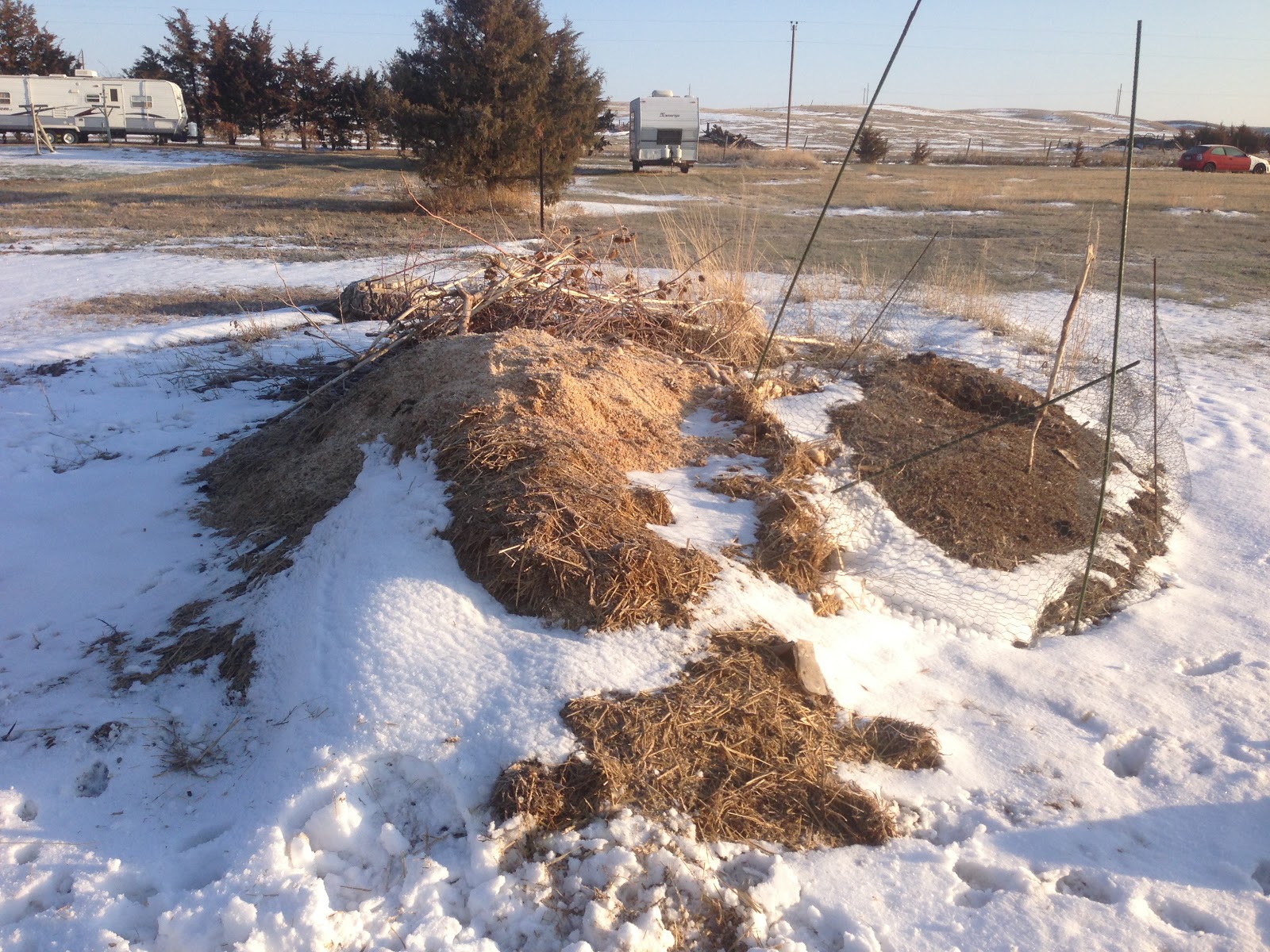
This winter's chicken bedding (straw and pine shavings) on the left, fresh compost ready for the garden on the right.
Last year's compost is ready to be spread around our veggie seedlings whenever winter finally gives up and goes back into hibernation.  And as we do every spring, we cleaned out the winter accumulation of poop in the chicken coop and started another huge pile that will become prime black, fluffy organic compost by this fall.  The chickens poop, the veggies grow, and the cycle continues.

Wednesday, April 17, 2013

Chicken graduation party!

As chicks morph from cute, fluffy little peeps to semi-feathered awkward adolescents, they become significantly less endearing.  Sort of like people.  Gone is the steady, soothing "cheap cheap" call, and along with it the feeling that maybe I'm a bit stingy with my money.  It is replaced by something akin to the squawking sound of a teenage boy making the transition from child to man.  The soft layer of fuzz gives way to rudimentary feathers, and eventually to a fully feathered miniature rendition of a full grown chicken. 

Even though they lose the appeal of cuteness, they begin to make up for it with self-reliance.  They require no special care once they are introduced to the general population of chickens, freeing us from making several trips a day to the chicken brooder in the garage to fill feeders, clean the bedding out of waterers, and check on their general health.  The big question, though, is exactly when and how do you introduce them to the big birds?  If it has been a cold spring with more cold forecast for the future, like this year, another layer of complexity is added to the equation.  How cold can the chickens handle?  Do you ease them into it, or take them straight from the warm coziness of the brooder to the somewhat uncontrolled conditions of the chicken coop?

We decided to make the transition as easy on them as possible.  I fenced off a corner of the chicken coop to keep the big birds from picking (and pecking) on them.  Chickens quickly establish the pecking order when new birds are introduced, but sometimes it can border on brutality, so it helps to give the young and old chickens a chance to size each other up for awhile before they can actually get at one another.  I also hung a heat lamp from the ceiling of the coop to provide them with some warmth on the cold nights.  I turn it off during the day so they become acclimated to the cold weather.  They are fully feathered, so as long as the change from warmth to coldness isn't too much of a shock, they should be able to handle low temperatures without any harm done.


"Whoa... what the heck are those things?  They're like us, but smaller."


The answer to the question "How did they get poop on the SIDE of the waterer?"
 

Our most curious and friendly hen. 


"BA-GAWK!!!"